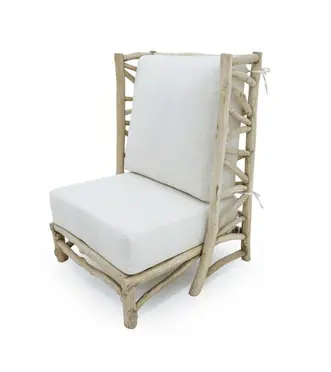
Reclined teak lounge chair · ikat-woven seat & back
| Material | Teak / Sumba ikat weave (seat & back) |
| Finish | Linseed oil |
| Dimensions | W 68 × D 85 × H 88 cm |
| Weight | 12 kg |
| Lead time | 6–8 weeks |
Made to order in Waingapu. 50% deposit on confirmation, balance before shipping.
Ships internationally by sea freight — see FAQ for lead times and destinations.
Custom dimensions available on request.
The Anakalang Chair is named after the ancient megalith village at the centre of Sumba. Where the Waikabubak Chair sits upright, the Anakalang reclines — the seat is angled 10° back and the back rest rises at 105° from the seat, putting the occupant in a position between working and resting.
Both the seat and the back panel are ikat-woven, made by the same family in Rende village. The back panel is a second, narrower piece woven on the same backstrap loom and lashed independently to the back post — so the two panels can have different motifs from the same dyeing session.
A living room lounge chair, a reading chair, a villa terrace accent. The reclined angle and the two ikat panels give it more presence than the Waikabubak — it reads as a statement piece where the other reads as a working chair.
Weight capacity 110 kg. Designed for interior use; suitable for covered outdoor spaces in dry season. See the wood care guide for maintenance.
Custom dimensions available — write to us.
Hand-lashed teak frame with mortise-and-tenon primary joints and rattan cord lashing at secondary junctions. The wider, lower geometry of the Anakalang requires three rattan bindings per rear joint for structural integrity at the recline angle.
Two separate ikat panels from Rende village, each woven independently. The seat panel is wider (52 cm); the back panel is narrower (44 cm). Both are hand-lashed to the frame. Either panel can be replaced independently.
Re-oil the teak frame once or twice per year with raw linseed or tung oil. Avoid silicone polish. The rattan cord bindings do not require treatment — they will weather to a dark silver over time. See wood care guide.
Dry-brush both panels. Avoid prolonged sunlight. Spot clean with cold water. The panels are independent — if one is damaged it can be replaced without replacing the other.